> For the complete documentation index, see [llms.txt](https://help.novacuraflow.com/llms.txt). Markdown versions of documentation pages are available by appending `.md` to page URLs; this page is available as [Markdown](https://help.novacuraflow.com/development/flow-studio/applications/server-content/generate-link.md).
# Generate link
Generate Link helps the user to construct a link which can be used to execute a workflow. This is supported for both User Workflows and Machine Workflows. Generate Link is located in the context menu in the server content panel.
### User Workflows
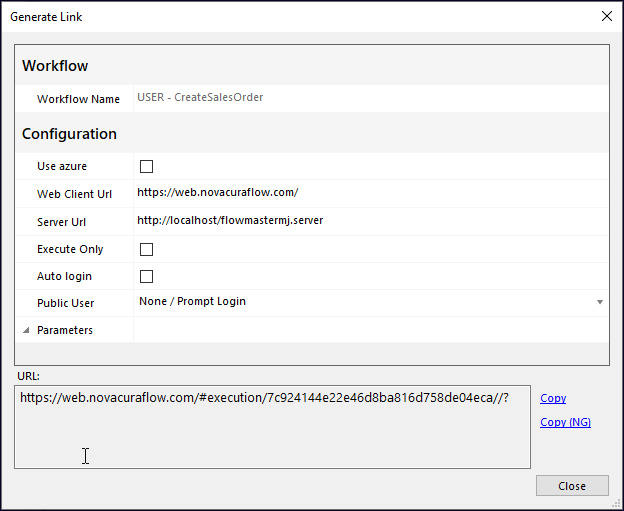
User workflow links point to the web client and provide a direct link to a workflow execution.
* **Web Client Url** this field should contain the url to the web client.
* If the link is for the new web client, the URL will always be the same
* If the link is for the legacy web client, the URL will differ per server
* **Server Url**
* If the link is for the legacy web client, leave this field empty
* If the link is for the new web client, add the URL to the server
* **Execute Only** locks the user to the execution view and prohibits the user from quitting the workflow or returning to a menu after execution.
* **Public User** this option configures a public user to run the execution, when a public user is selected no credential prompt will be displayed.
* **Parameters** this sections show the input variables that are configured in the start event of the workflow. Only simple variables can be used in user workflows.
Click **Copy** to copy the link for the legacy web client.
Click **Copy (NG)** to copy the link for the new web client.
### **Mobile Link**
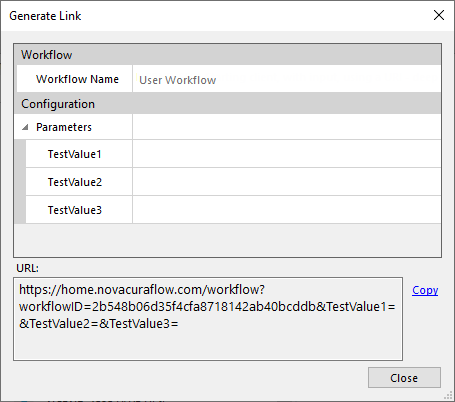
User workflow links point to the mobile client and provides a direct link to a workflow execution.
* **Parameters** these sections show the input variables that are configured in the start event of the workflow. Only simple variables can be used in user workflows.
### Machine Workflows
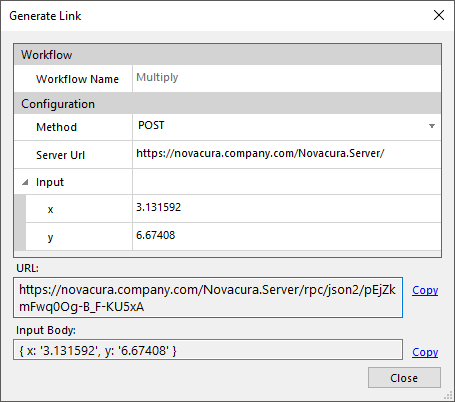
Machine workflows can be executed over http request. These requests are made directly to the flow server. The workflow is executed by a machine user and authentication is made by basic authentication.
* **Method** supported methods are POST and GET, POST supports complex structures as input and GET only supports simple variables fetched as query string values.
* **Server URL** url to server, must be accessible from where the request is made.
* **Input** in this section all simple variables are shown and provide a help function for constructing the input parameters. In POST requests the input should be sent as JSON in body content and GET should send input variables as part of the url.
{% hint style="info" %}
The default execution timeout is **10 minutes** for calls to the rpc/json2 endpoint. \
To increase this timeout, add the *workflowTimeout* query parameter with the timeout value in *milliseconds*, like:\
\
For long-running workflows, the above needs to be taken into consideration in addition to the executionTimeout in the server web.config file as well as timeout settings for any proxies in between the client and the Flow Server.
{% endhint %}
---
# Agent Instructions
This documentation is published with GitBook. GitBook is the documentation platform designed so that both humans and AI agents can read, navigate, and reason over technical content effectively. Learn more at gitbook.com.
## Querying This Documentation
If you need additional information that is not directly available in this page, you can query the documentation by asking a question.
Perform an HTTP GET request on the following URL with the `ask` and `goal` query parameters:
```
GET https://help.novacuraflow.com/development/flow-studio/applications/server-content/generate-link.md?ask=&goal=
```
`ask` is the immediate question: it should be specific, self-contained, and written in natural language.
`goal` is what the user is ultimately trying to achieve, the reason they need the answer. Sharing it helps GitBook give you a better, more relevant answer. A goal is most helpful when it describes the outcome the user wants rather than restating the question. For example, with `ask=how do I create an API token`, a goal like `automate deployments from our CI pipeline` lets GitBook tailor the answer to that use case.
The response will contain a direct answer to the question and relevant excerpts and sources from the documentation.
Use this mechanism when the answer is not explicitly present in the current page, you need clarification or additional context, or you want to retrieve related documentation sections.